
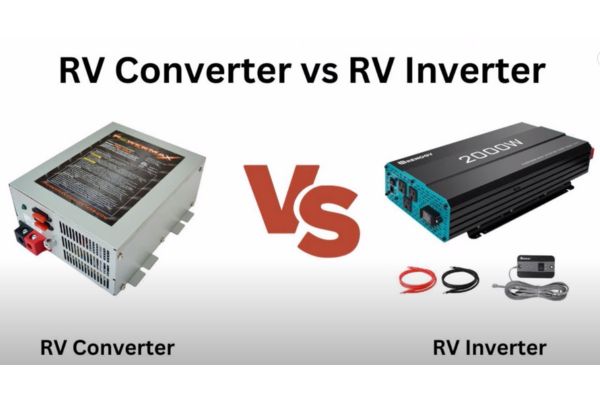
Confused about RV converters vs inverters? Learn what each does, key differences, and how to test both at home, plus when to call a pro.
If you own an RV, you’ve probably heard the terms “converter” and “inverter” tossed around like they mean the same thing. They don’t. These two components handle completely different jobs in your RV’s electrical system, and mixing them up can send you chasing the wrong problem when something stops working.
This guide breaks down exactly what each device does, how to tell them apart, and how you can test both at home before you call in a professional for RV Repairs.
What Is an RV Converter?
An RV converter takes the 120-volt AC power coming from a campground hookup or generator and converts it into 12-volt DC power. Your RV’s interior lights, water pump, furnace fan, and control panels all run on 12-volt DC, so the converter acts as the bridge that makes shore power usable for those systems.
At the same time, a converter charges your RV’s house batteries. When you plug into shore power, the converter doesn’t just power your appliances directly, it also trickles a charge into your battery bank so you have reserve power when you disconnect and head down the road.
In short: a converter changes AC to DC, and it keeps your batteries topped off while you’re plugged in.
What Is an RV Inverter?
An inverter does the opposite job. It takes 12-volt DC power stored in your batteries and converts it into 120-volt AC power, the kind of electricity that runs your microwave, TV, laptop charger, and other household-style outlets.
Inverters come in two main types:
- Modified sine wave inverters more affordable, but not ideal for sensitive electronics.
- Pure sine wave inverters deliver cleaner, more stable power, similar to what you get from a wall outlet at home. These work better with laptops, medical equipment, and modern electronics.
Without an inverter, any AC-only appliance in your rig simply won’t function when you’re boondocking or driving without a generator or shore power connection.
Converter vs Inverter: The Core Difference
| Feature | Converter | Inverter |
| Power direction | AC to DC | DC to AC |
| Power source | Shore power / generator | House batteries |
| Charges batteries? | Yes | No |
| Power AC outlets? | No | Yes |
| Used when | Plugged in | Off-grid / driving |
Think of it this way: the converter feeds your batteries and 12-volt system when you’re connected to power, while the inverter feeds your AC outlets when you’re disconnected and running off battery reserves. Many RVs run both systems simultaneously, and some newer rigs use a combined converter/inverter/charger unit to handle both functions in one box.
Why This Distinction Matters for Troubleshooting
A lot of RV owners assume any electrical hiccup is one big mystery, but knowing which component is misbehaving saves time and money. If your lights are dim or your battery won’t hold a charge while plugged in, the converter is the likely culprit. If your microwave or TV won’t turn on while boondocking, look at the inverter first.
Getting this wrong means you might spend hours testing the wrong part, or worse, pay for a service call that doesn’t actually target the real issue. A shop that offers All RV Repairs should always start diagnostics by isolating which system is failing before opening anything up.
How to Test an RV Converter
Testing a converter doesn’t require advanced tools. Here’s a straightforward process you can run yourself:
- Plug your RV into shore power. Make sure the power source is confirmed working with a separate device first.
- Grab a multimeter. Set it to DC voltage.
- Locate your converter’s output terminals, usually near the battery compartment or inside a power distribution panel.
- Test the DC output. A healthy converter should read somewhere between 13.2 and 14.4 volts DC while charging.
- Check your 12-volt appliances. Turn on interior lights or the water pump. If they run dim or don’t respond at all while plugged into shore power, the converter likely isn’t delivering the correct output.
- Inspect the fuse and connections. A blown fuse or corroded wire often mimics a failed converter, so rule these out before assuming the unit itself is bad.
If your multimeter reading falls well outside the 13-14 volt range, or if you see 0 volts, the converter is likely failing and needs replacement or repair.
How to Test an RV Inverter
Testing an inverter follows a similar approach but checks the opposite direction of power flow:
- Disconnect from shore power and turn off the generator. You want to confirm the inverter is pulling only from batteries.
- Turn the inverter on using its dedicated switch, usually located near the breaker panel or battery bay.
- Set your multimeter to AC voltage and test an outlet that’s wired to the inverter (not every outlet in an RV runs through the inverter, so check your owner’s manual for which ones do).
- Look for a reading close to 120 volts AC. Anything significantly lower, or no reading at all, points to an inverter problem.
- Test with an actual appliance. Plug in something simple like a phone charger or small lamp to confirm real-world function, not just voltage on the meter.
- Check the battery charge level first. A low or dead battery bank can make a perfectly healthy inverter appear broken, since it has nothing to convert.
If the inverter fails to produce power even with a fully charged battery bank, the unit itself, its fuse, or its wiring connections likely need attention.
Common Signs of Converter or Inverter Failure
- Batteries drain quickly even after being plugged in overnight (converter issue)
- Interior lights flicker or dim while on shore power (converter issue)
- AC outlets don’t work while off-grid despite charged batteries (inverter issue)
- A humming or buzzing noise from the inverter with no output (inverter issue)
- Burning smell or visible corrosion near either unit (stop use immediately and call a professional)
When to Call a Professional
Basic voltage testing is safe for most RV owners to do themselves, but replacing a converter or inverter involves working around battery banks and AC wiring, which carries real risk if you’re not familiar with electrical systems. If your testing points to a failed unit, or if you’re not comfortable working near your battery compartment, it’s time to bring in a shop that specializes in RV & Auto Repairs.
Hudson Automotive Repair & Service works on these systems daily, from simple converter swaps to full electrical diagnostics on Airstreams, conversion vans, and travel trailers. If your rig isn’t holding a charge or your outlets have gone quiet, our team can pinpoint the issue and get you back on the road without the guesswork.
FAQs
Q: What’s the simplest way to tell a converter from an inverter?
A converter turns shore power into battery-charging power (AC to DC). An inverter turns battery power into outlet power (DC to AC). If you’re plugged in, the converter is working. If you’re off-grid and running AC appliances, the inverter is working.
Q: Can an RV run without an inverter?
Yes. Many RVs operate fine without an inverter as long as you don’t need AC-powered appliances like microwaves or TVs while off-grid. The 12-volt systems (lights, water pump, furnace) run through the converter and battery, not the inverter.
Q: Why do my RV batteries die even though I’m plugged into shore power?
This usually points to a failing converter that isn’t delivering the correct charging voltage. Test the DC output with a multimeter; a healthy converter reads between 13.2 and 14.4 volts.
Q: Do all RV outlets run through the inverter?
No. Most RVs wire only specific outlets to the inverter, while others only work on shore power or generator. Check your owner’s manual or wiring diagram to know which outlets are inverter-powered.
Q: How much does it cost to replace an RV converter or inverter?
Costs vary based on the unit’s size, brand, and whether it’s a standalone converter/inverter or a combined system. A shop offering All RV Repairs can inspect your specific setup and provide an accurate quote after diagnostics.
Q: Can I test my converter or inverter without a multimeter?
You can get a rough sense by observing symptoms (dim lights, dead batteries, non-working outlets), but a multimeter gives an accurate voltage reading and is the only reliable way to confirm a failure before replacing parts.